Hemofilie en gentherapieën
Hemofilie behandelen kan met gentherapie.
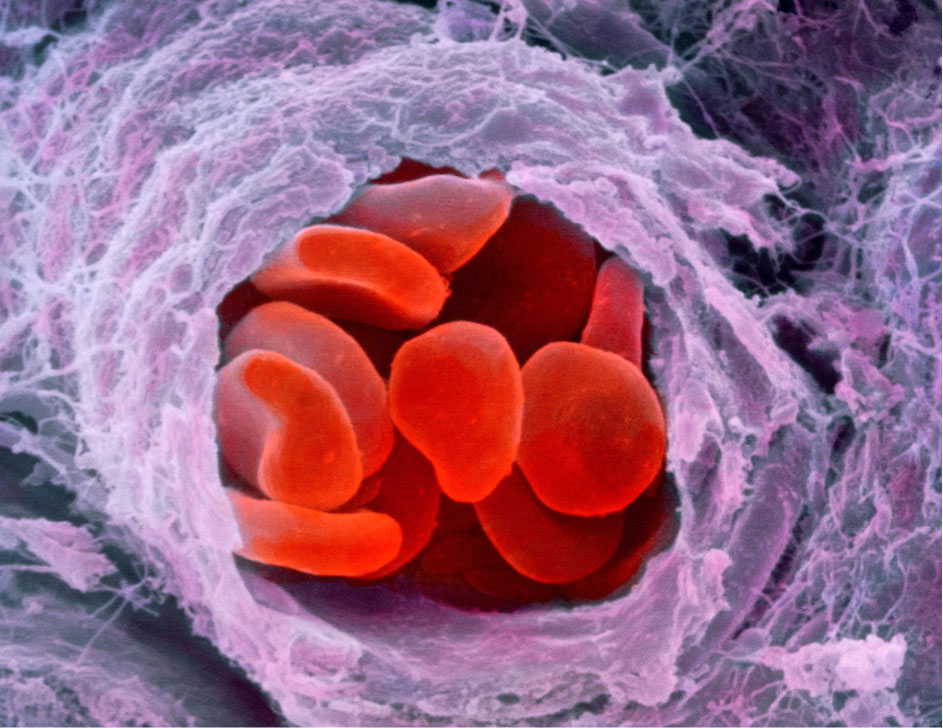
GENTHERAPIE VOOR HEMOFILIE
GENTHERAPIEËN OP MAAT VAN HEMOFILIE
Hemofiliepatiënten hebben een schadelijke mutatie in hun factor VIII- (hemofilie A) of factor IX genetisch materiaal (hemofilie B). Die mutatie leidt tot een verlaagde productie van functionele stollingsfactoren, waardoor patiënten vatbaar zijn voor bloedingen.1
Na tientallen jaren onderzoek begrijpen wetenschappers nu dat hemofilie wordt veroorzaakt door mutaties in één enkel gen. Dit maakt van hemofilie een perfect doelwit voor gentherapie,1 waarbij virale vectoren kunnen worden gebruikt om één therapeutisch transgen af te leveren.2
HOE WERKT AAV-GENTHERAPIE VOOR HEMOFILIE?
Elke gentherapie bestaat uit vijf belangrijke stappen:
-

Adeno-geassocieerd virus
1. Adeno-geassocieerde virale (AAV) vector omhulsel selecteren
Om het transgen te kunnen afleveren, moet het worden verpakt in een leveringsmiddel: het omhulsel. AAV’s zijn geëvolueerd om verschillende celtypes te kunnen binnendringen. Dat doen ze door de receptoren op het oppervlak van hun omhulsel of capside te veranderen. De keuze van het omhulsel zal afhangen van het doelweefsel, van het veiligheidsprofiel van het transgen, of het een lokale aflevering vereist of in het hele lichaam3 en van de hoeveelheid neutraliserende antilichamen in de patiënt.4
-
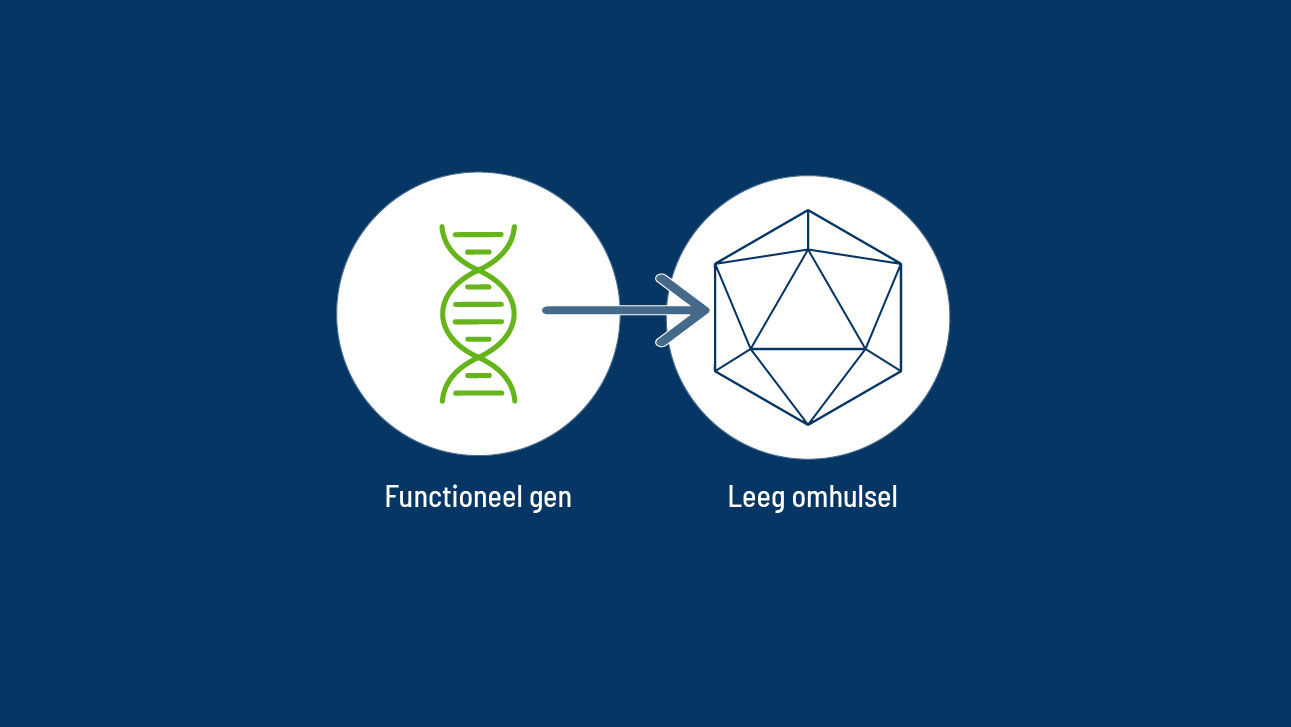
Functioneel gen om de schaal leeg te maken
2. Productie van de recombinante AAV-vector (rAAV)
De volgende stap is het creëren van een rAAV uit een AAV. Dit gebeurt door het verwijderen van het virale DNA en ze te vervangen door het factor VIII- of IX-transgen.1,3
-
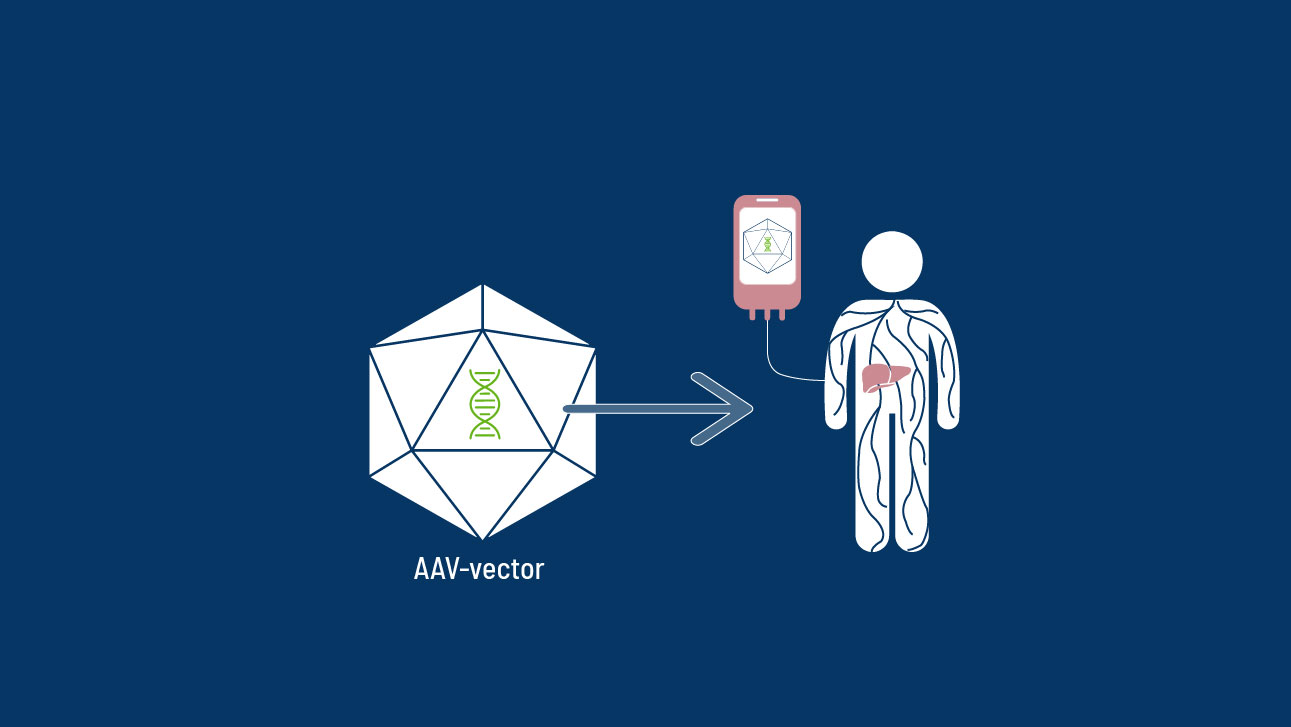
AAV-vector
3. Aflevering van het transgen
In de huidige onderzoeken naar gentherapieën met AAV-vectoren wordt de behandeling meteen in de ader, in de spieren in het centrale zenuwstelsel, in het hart of in de longen toegediend. In het geval van hemofilie is een toediening via de ader optimaal voor het doelweefsel: de lever.3 De toediening gebeurt met een enkele veneuze injectie.5
-
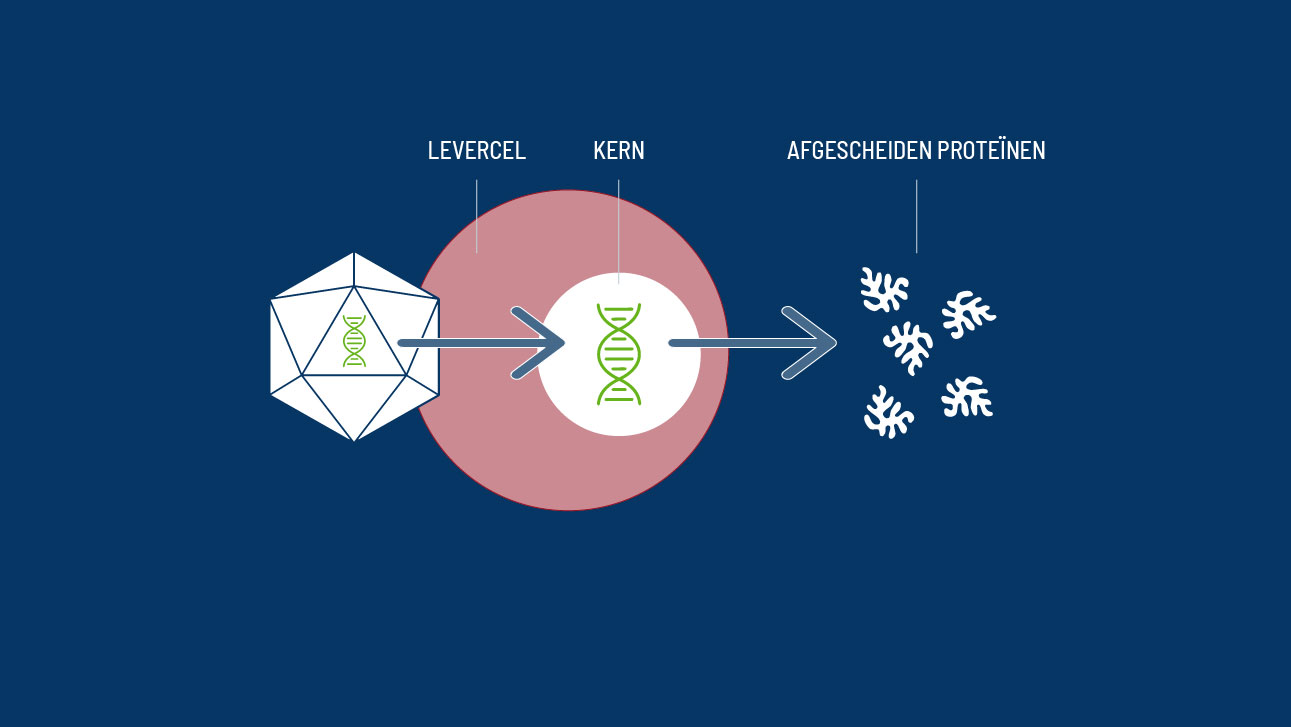
Levercel met kern.
4. Integratie van het transgen
Eenmaal in het lichaam van de patiënt zullen de pakketjes met rAAV die in contact komen met levercellen van de patiënt, zich aan de cel hechten. Het hechten veroorzaakt de absorbtie van de rAAV in de levercel. Na een sortering in de cel, wordt het genetisch materiaal van de rAAV in de celkern geïmporteerd. De cel leert zo zelf aan om de missende stollingsfactor aan te maken.6
-
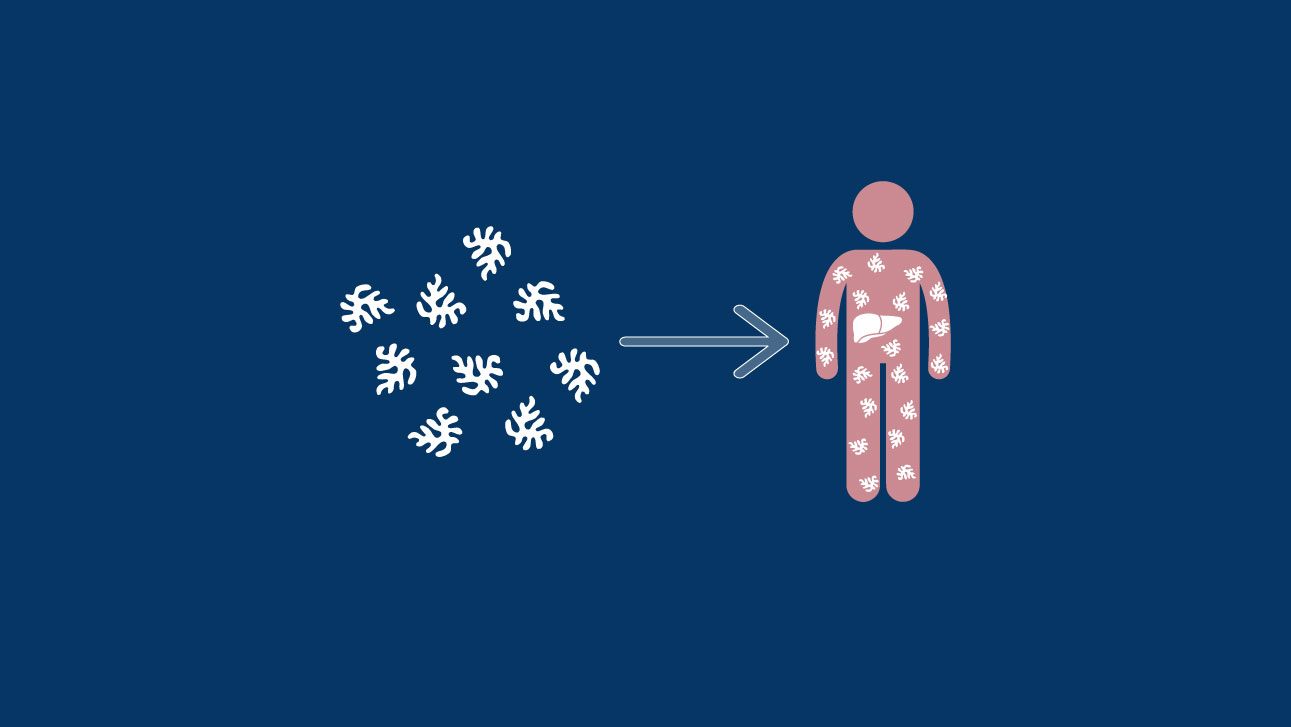
5. Therapeutisch resultaat
Tijdens klinische proeven waren bijna alle patiënten geholpen met gentherapie en daalde het gemiddeld aantal bloedingen en toegediende vervangingsfactoren.5,7
Het klinisch gebruik van op AAV-gebaseerde gentherapie voor hemofilie wordt al bijna twee decennia lang onderzocht,8 met als doel de behandeling verbeteren én patiënten verlossen van het zware behandelingsschema.5,7,14
Voor gentherapie met een AAV-vector wordt het natuurlijk virus nagemaakt en onschadelijk gemaakt. Er zijn heel wat AAV-subtypes die mensen infecteren. Elk van deze subtypes heeft verschillende kenmerken die wetenschappers kunnen gebruiken om een gentherapie op maat te maken voor een bepaalde ziekte.9HEMOFILIE: HET OPTIMALE DOEL VOOR GENTHERAPIE
HEMOFILIE IS DE OPTIMALE KANDIDAAT VOOR GENTHERAPIE
Hemofilie is een monogene, X-gebonden erfelijke ziekte. Functionele schadelijke mutaties in de factor VIII- of IX-genen veroorzaken een tekort aan functionele stollingsfactoren, waardoor patiënten vatbaar zijn voor gevaarlijke bloedingen.1 De behandeling voor deze ziekte is levenslang en belastend, zowel lichamelijk, geestelijk als financieel.
Hoewel hemofilie zonder enige twijfel een slopende ziekte is, is het goed nieuws dat hemofilie dankzij deze kenmerken een optimaal doel is voor gentherapie.
WAARDOOR IS HEMOFILIE GESCHIKT VOOR GENTHERAPIE?
Het doel van gentherapie is het behoud van een langdurige productie van een therapeutisch gen om de symptomen van een ziekte te verbeteren of zelfs te genezen.2 Helaas komen niet alle ziekten in aanmerking voor dit type therapie. Compatibiliteit met gentherapieën hangt af van verschillende factoren, waaronder:


VORIGE
Gentherapie
VOLGENDE
Startpagina
Referenties
- Doshi BS, Arruda VR. Gene therapy for hemophilia: what does the future hold? Ther Adv Hematol. 2018;9(9):273-293.
- High KA, Roncarolo MG. Gene Therapy. N Engl J Med. 2019;381(5):455-464.
- Naso MF, Tomkowicz B, Perry WL III, Strohl WR. Adeno-associated virus (AAVI as a vector for gene therapy. BioDrugs. 2017;31:317-334.
- Tseng Y-S, Agbandje-McKenna M. Mapping the AAV capsid host antibody response toward the development of second generation gene delivery vectors. Frontiers Immunol. 2014;5(9):1-11.
- Nathwani AC, Reiss UM, Tuddenham EGD, et al. Long-term safety and efficacy of factor IX gene therapy in hemophilia B. N Engl J Med. 2014;371:1994-2004.
- Wang D, Tai PW, Gao G. Adeno-associated virus vector as a platform for gene therapy delivery. Nat Rev Drug Discov. 2019;18(5):358-378.
- Rangarajan S, Walsh L, Lester W, et al. AAV5-Factor VII Gene Transfer in Severe Hemophilia A. N Engl J Med. 2017;377(26):2519-2530.
- Arruda V, Stedman H, Jian H, et al. Correction of hemophilia B phenotype by novel method of regional intravenous delivery of AAV vector to skeletal muscle of hemophilia B dogs. Mol Ther. 2005;11:S233.
- Daya S, Berns KI. Gene thearpy using adeno-associated virus vectors. Clin Micro Rev. 2008;583-593.
- Pipe S, Leebeek FWG, Ferreira V, Sawyer EK, Pasi J. Clinical considerations for capsid choice in the development of liver-targeted AAV-based gene transfer. Mol Ther Methods Clin Dev. 2019;15:170-178.
- Perrin GQ, Herzog RW, Markusic DM. Update on clinical gene therapy for hemophilia. Blood. 2019;133(5):407-414.
- Arruda VR, Doshi BS. Gene therapy for hemophilia: facts and quandaries in the 21st century. Med J Hematol Infect Dis. 2020;12(1):e2020069.
- Nathwani AC. Hematology Am Soc Hematol Educ Program. 2019;2019(1):1-8.
- Klamroth A. et al. Global Seroprevalence of Pre-existing Immunity Against AAV5 and Other AAV Serotypes in People with Hemophilia A. Hum Gene Ther. 2022;33(7-8):432-441. Epub 16 maart 2022.
HEBT U EEN VRAAG? CONTACTEER ONS
Bedankt voor uw vraag!
<p>Wij nemen snel contact met u op.</p>